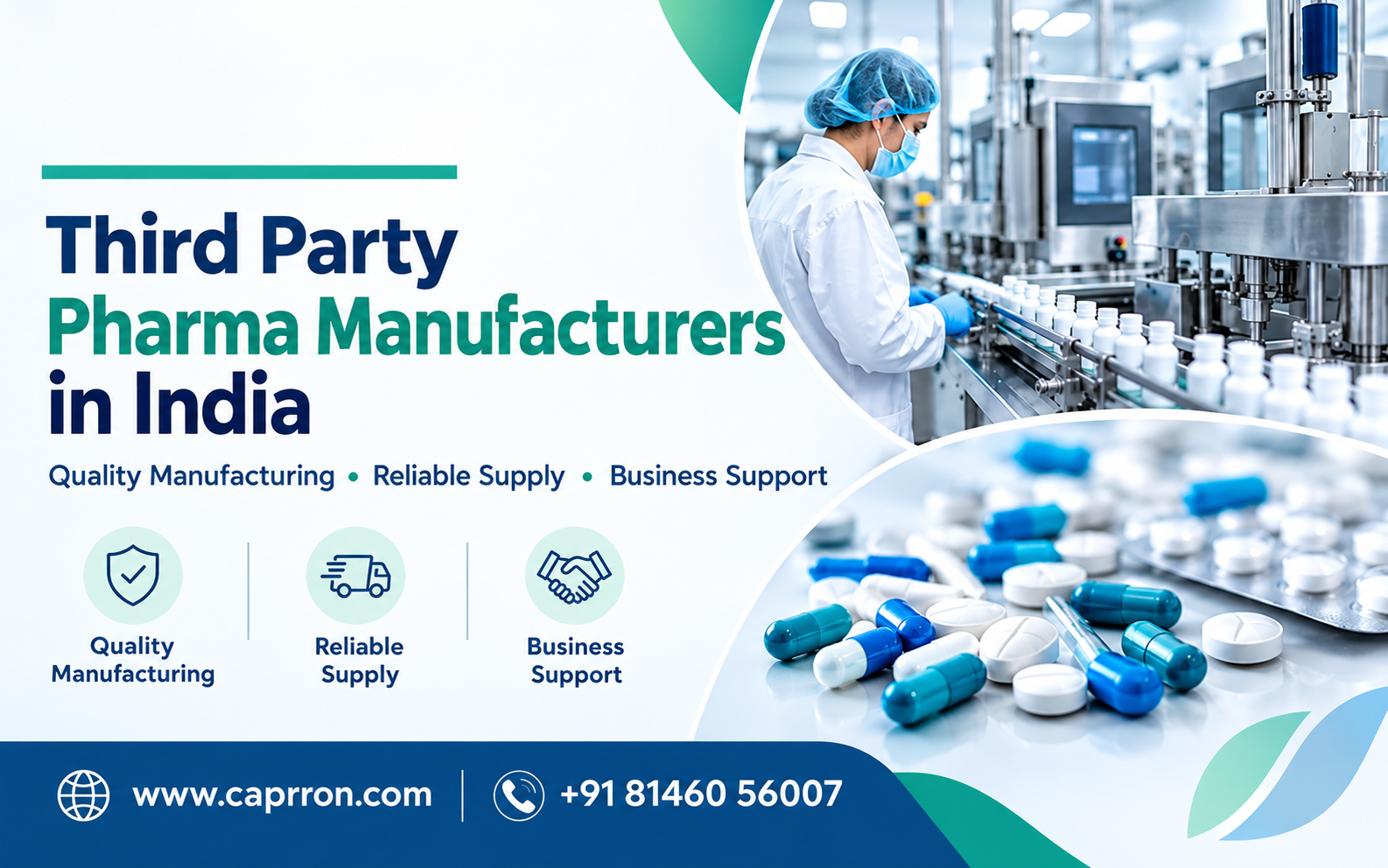
Third Party Pharma Manufacturers in India help pharmaceutical companies, marketers, startups, and healthcare businesses manufacture medicines under their own brand without establishing and operating a complete manufacturing facility. This business model allows companies to focus on product development, branding, marketing, sales, and distribution while an experienced manufacturing partner manages production and quality processes.
India has a well-established pharmaceutical manufacturing ecosystem with facilities producing a wide range of pharmaceutical formulations. Third-party manufacturing can be useful for businesses that want to expand their product portfolio, enter new therapeutic segments, or increase production capacity without making the substantial investment required to build their own manufacturing infrastructure.
Caprron Healthcare – Pharma Manufacturing Solutions in India
Caprron Healthcare provides pharmaceutical and nutraceutical manufacturing solutions for businesses looking for reliable production support in India. The company focuses on manufacturing requirements, product quality, formulation support, packaging, and supply coordination.
Businesses can visit http://caprron.com/ to learn more about Caprron Healthcare and its manufacturing services.
When selecting a Pharma Third Party Manufacturing Company, businesses should consider manufacturing capabilities, product range, quality systems, regulatory compliance, production capacity, documentation, packaging options, and communication processes.
A suitable manufacturing partner can help a pharmaceutical business develop a more organized supply chain while allowing its internal team to concentrate on marketing and business development.
What Is Third Party Pharma Manufacturing?
Third-party pharma manufacturing is a business arrangement in which one pharmaceutical company or brand owner contracts another pharmaceutical manufacturer to produce medicines on its behalf.
The manufacturing company generally manages activities related to production, quality control, packaging, and batch processing according to agreed specifications. The marketing or pharmaceutical company can then sell the finished products under its own brand, subject to applicable regulatory and contractual requirements.
This model is also commonly associated with contract manufacturing. The exact responsibilities of each party depend on the agreement, product category, applicable licenses, and regulatory requirements.
For pharmaceutical businesses, this approach can provide access to established manufacturing infrastructure without requiring them to build every production facility themselves.
Why Businesses Choose Third Party Pharma Manufacturers in India
The pharmaceutical industry requires specialized infrastructure, trained personnel, quality-control systems, documentation, equipment, and regulatory processes. Building these capabilities internally can require significant investment and ongoing operational management.
Working with Third Party Pharma Manufacturers can provide several practical advantages.
Reduced Manufacturing Infrastructure Investment
A company does not necessarily need to establish a complete manufacturing plant before launching its products. By working with an established manufacturer, businesses can utilize existing production infrastructure according to their contractual arrangement.
Access to Established Production Facilities
Experienced manufacturers may have dedicated facilities and equipment for different dosage forms. Depending on the manufacturer, these can include tablets, capsules, syrups, dry syrups, powders, softgels, and other formulations.
Product Portfolio Expansion
A business can work with a manufacturing partner to introduce additional formulations and strengthen its product portfolio. This can be particularly useful for companies entering new therapeutic or healthcare categories.
Greater Focus on Marketing and Distribution
When production activities are handled by a manufacturing partner, the brand-owning company can dedicate more resources to marketing, sales, customer relationships, distribution, and market expansion.
Scalable Production
Third-party manufacturing can provide businesses with access to manufacturing capacity without requiring them to maintain the entire infrastructure themselves. Production planning can be discussed according to product requirements, demand, and agreed batch sizes.
How Third Party Pharma Manufacturing Works
The process generally begins with identifying the products a pharmaceutical company wants to manufacture. The manufacturer and client then discuss formulation requirements, packaging, quantities, pricing, documentation, and timelines.
A typical process may include the following stages:
- Product selection and requirement discussion
- Manufacturer evaluation
- Formulation and product specification review
- Commercial quotation and agreement
- Packaging and artwork finalization
- Raw material and production planning
- Manufacturing and in-process quality checks
- Finished-product testing
- Packaging and batch documentation
- Dispatch according to agreed requirements
The actual process may differ depending on the product, regulatory category, manufacturing arrangement, and responsibilities assigned to each party.
Importance of Quality Standards in Pharma Manufacturing
Quality is one of the most important considerations when selecting a manufacturing partner. Pharmaceutical manufacturing involves multiple controlled processes, from raw-material handling through production, packaging, testing, and release.
The World Health Organization explains that GMP is a quality-assurance system intended to ensure pharmaceutical products are consistently produced and controlled according to appropriate quality standards. GMP addresses areas such as production, quality control, personnel, premises, materials, documentation, validation, and defined procedures.
Indian pharmaceutical manufacturing is regulated under the Drugs and Cosmetics Act, 1940 and Drugs and Cosmetics Rules, 1945, with regulatory responsibilities involving the appropriate authorities. CDSCO also publishes regulatory guidance and information related to pharmaceutical manufacturing and GMP.
Therefore, businesses should verify the relevant manufacturing licenses, approvals, certifications, quality systems, and product-specific regulatory requirements before entering into a manufacturing arrangement.
Key Factors to Consider When Choosing Third Party Pharma Manufacturers
Choosing a manufacturing partner should involve more than comparing quotations. Pharmaceutical products require controlled manufacturing and documentation, so businesses should conduct appropriate due diligence.
Manufacturing Experience
Consider the manufacturer’s experience with the particular dosage form and product category you require. Experience with a relevant product type can make communication and production planning more straightforward.
Manufacturing Infrastructure
Review the available manufacturing facilities, equipment, production areas, storage arrangements, and quality-control infrastructure where appropriate.
Quality Control System
A manufacturer should have defined quality-control procedures covering raw materials, in-process checks, finished products, and documentation.
Regulatory Compliance
Check relevant licenses, manufacturing permissions, certifications, and other applicable regulatory documentation. Requirements can vary according to the product and dosage form.
Production Capacity
Production capacity should be evaluated against your expected requirements. A manufacturer should be able to discuss batch sizes, production schedules, and realistic delivery timelines.
Packaging Capabilities
Packaging contributes to product protection, identification, storage, and presentation. Discuss packaging formats, artwork requirements, labeling information, and applicable compliance requirements before production.
Documentation
Clear documentation helps both parties maintain traceability and accountability. Depending on the arrangement, documentation may include specifications, batch records, test reports, invoices, agreements, and other relevant records.
Regulatory Compliance and GMP in Pharmaceutical Manufacturing
Regulatory compliance is an important part of pharmaceutical manufacturing in India. CDSCO materials reference GMP requirements and quality systems for pharmaceutical manufacturing, while the Drugs Rules include provisions covering production, quality control, self-inspection, distribution, complaints, and product recalls.
WHO also identifies GMP as an important part of pharmaceutical quality assurance because testing alone cannot eliminate every manufacturing risk. GMP therefore focuses on controlled processes, suitable facilities and materials, trained personnel, documentation, validation, and quality systems.
For this reason, pharmaceutical businesses should avoid selecting a manufacturer solely on the basis of price. Manufacturing capability, quality procedures, regulatory documentation, product requirements, and supply reliability should also be considered.
Products Commonly Covered by Third Party Pharma Manufacturing
Depending on the manufacturing facility and applicable approvals, third-party pharmaceutical manufacturing may cover various dosage forms.
Common categories can include:
- Tablets
- Capsules
- Hard gelatin capsules
- Softgel capsules
- Syrups
- Dry syrups
- Oral liquids
- Powders
- Sachets
- Nutraceutical formulations
- Protein and nutritional products
- Other approved pharmaceutical formulations
The actual product range varies from one manufacturing facility to another. Businesses should confirm whether the required formulation and composition can legally and technically be manufactured at the selected facility.
Benefits of Working With a Pharma Third Party Manufacturing Company
A Pharma Third Party Manufacturing Company can become an important part of a pharmaceutical company’s supply chain.
Some practical benefits include:
- Access to established manufacturing infrastructure
- Reduced need for independent production facilities
- Potentially lower capital expenditure on manufacturing infrastructure
- Flexible product portfolio development
- Support for branded product manufacturing
- Access to specialized production equipment
- Quality-control and testing processes
- Packaging and labeling coordination
- Production planning support
- Opportunity to expand into new markets
However, the benefits depend on the manufacturer’s capabilities, the contractual arrangement, product requirements, order volumes, and applicable regulations.
How to Start a Third Party Pharma Manufacturing Business
Businesses planning to enter pharmaceutical marketing through third-party manufacturing should begin with proper product and market planning.
First, identify the therapeutic or healthcare segment you want to target. Next, determine the products required, dosage forms, strengths, packaging formats, and expected market demand.
After that, shortlist suitable Third Party Pharma Manufacturers in India and compare their capabilities.
Important areas to discuss include:
- Product availability
- Manufacturing location
- Manufacturing licenses
- Quality certifications
- Product specifications
- Minimum order quantities
- Packaging options
- Pricing
- Production timelines
- Payment terms
- Testing and documentation
- Transportation and delivery
- Product complaint and recall procedures
A clear agreement between the parties can help define responsibilities and reduce misunderstandings during manufacturing and supply.
Important Questions to Ask Third Party Pharma Manufacturers
Before finalizing a manufacturer, pharmaceutical companies should prepare a detailed checklist.
Is the manufacturer licensed for the required product?
Confirm that the facility has the appropriate manufacturing authorization for the products and dosage forms involved.
Does the manufacturer have suitable quality systems?
Ask about quality-control procedures, testing, documentation, validation, and applicable GMP compliance.
What is the minimum order quantity?
Minimum order requirements can vary according to formulation, packaging, batch size, and manufacturing capacity.
What documentation is provided?
Clarify which batch, quality, manufacturing, and commercial documents will be supplied with the finished products.
What is the expected production timeline?
Discuss manufacturing and dispatch timelines before confirming purchase orders.
Can the manufacturer support packaging requirements?
Confirm whether the manufacturer can provide or coordinate the required packaging format, labeling, and artwork specifications.
Informative Checklist for Selecting a Third Party Manufacturer
Before signing a manufacturing agreement, businesses can use the following checklist:
- Verify manufacturing authorization and applicable licenses.
- Review relevant quality certifications.
- Confirm dosage-form manufacturing capabilities.
- Check production capacity.
- Discuss minimum order quantities.
- Review quality-control procedures.
- Clarify testing and documentation.
- Discuss packaging and labeling requirements.
- Confirm production and delivery timelines.
- Establish responsibilities for complaints and recalls.
- Review commercial and payment terms.
- Maintain clear written agreements between both parties.
This type of due diligence can help a company establish a more transparent and organized manufacturing relationship.
Why India Is an Important Pharmaceutical Manufacturing Market
India has a large pharmaceutical manufacturing ecosystem serving domestic and international markets. Regulatory bodies such as CDSCO provide information, guidance, and regulatory resources for pharmaceutical manufacturers and other stakeholders. CDSCO also maintains published information concerning WHO-GMP-certified manufacturing units and pharmaceutical regulatory requirements.
India’s manufacturing ecosystem includes companies involved in formulations, active pharmaceutical ingredients, contract manufacturing, nutraceuticals, and other healthcare products. For businesses seeking manufacturing partnerships, this provides opportunities to evaluate manufacturers based on their particular product, quality, capacity, and commercial requirements.
Why Choose Caprron Healthcare for Pharma Manufacturing?
Caprron Healthcare offers pharmaceutical and nutraceutical manufacturing solutions for businesses looking to develop and manufacture healthcare products.
A manufacturing partnership should be based on clearly defined product requirements, quality expectations, documentation, production planning, and commercial terms. Caprron Healthcare can be contacted through its website for information about available manufacturing services and product requirements.
Website: http://caprron.com/
For businesses searching for Third Party Pharma Manufacturers in India, visiting the company’s website and discussing specific product requirements can be a practical starting point.
Frequently Asked Questions About Third Party Pharma Manufacturers in India
What are Third Party Pharma Manufacturers in India?
Third Party Pharma Manufacturers in India are manufacturing companies that produce pharmaceutical products for other businesses under a contractual or agreed manufacturing arrangement. The client generally markets the products under its own brand, subject to applicable regulatory requirements.
What is a Pharma Third Party Manufacturing Company?
A Pharma Third Party Manufacturing Company provides manufacturing services to pharmaceutical businesses that want their products manufactured without operating their own complete manufacturing facility.
What products can be manufactured through third-party manufacturing?
Depending on the facility and applicable approvals, products can include tablets, capsules, syrups, powders, softgels, sachets, and other pharmaceutical or healthcare formulations.
How do I select Third Party Pharma Manufacturers?
Businesses should evaluate manufacturing authorization, product capabilities, quality systems, certifications, infrastructure, production capacity, documentation, pricing, minimum order quantities, and delivery timelines.
Is GMP important for pharmaceutical manufacturing?
Yes. GMP is an important quality-assurance framework for pharmaceutical manufacturing. WHO states that GMP helps ensure medicines are consistently produced and controlled according to appropriate quality standards.
What should I check before placing an order?
Check the manufacturer’s relevant licenses, product capabilities, quality systems, specifications, batch requirements, packaging, documentation, pricing, production timeline, and contractual responsibilities.
Can third-party manufacturing help expand a pharmaceutical product portfolio?
Yes. A suitable manufacturing arrangement can allow a pharmaceutical business to add products without establishing every manufacturing capability internally. The feasibility depends on the manufacturer, formulation, regulatory requirements, production capacity, and commercial agreement.
Conclusion
Third Party Pharma Manufacturers in India provide an important manufacturing option for pharmaceutical businesses that want to develop and market products without independently establishing complete manufacturing infrastructure. By working with an experienced manufacturing partner, companies can focus on branding, marketing, distribution, and business development while production is handled according to agreed specifications and applicable regulatory requirements.
Selecting the right Third Party Pharma Manufacturers requires careful evaluation of manufacturing capabilities, quality systems, regulatory documentation, product range, infrastructure, capacity, packaging, pricing, and supply timelines.
For pharmaceutical and nutraceutical businesses exploring manufacturing opportunities, Caprron Healthcare provides manufacturing solutions that can be explored through http://caprron.com/. A clear understanding of product requirements and a detailed discussion with the manufacturer can help establish an organized and transparent manufacturing partnership.