Liposomal Supplement Manufacturer: A Complete Guide to Liposomal Nutraceutical Manufacturing in Indi
A Liposomal Supplement Manufacturer develops specialized nutraceutical formulations designed to deliver selected nutrients using liposomal technology. This approach uses microscopic lipid-based structures to encapsulate active ingredients and support their stability, dispersion, and delivery. With growing interest in innovative wellness products, liposomal supplements are becoming an important area of development for nutraceutical brands seeking differentiated product formulations.
Liposomal formulations are being explored for vitamins, minerals, antioxidants, and other selected nutritional ingredients. However, the performance of a liposomal supplement depends on several factors, including ingredient compatibility, lipid composition, manufacturing processes, product stability, and quality testing. Choosing an experienced manufacturing partner is therefore an important step for businesses planning to introduce liposomal products to the market.
India’s nutraceutical industry provides opportunities for supplement brands, distributors, healthcare businesses, and entrepreneurs to develop specialized nutritional products. Working with a capable manufacturer can help businesses assess suitable formulations, select appropriate packaging, establish quality requirements, and plan commercial production.
This guide explains liposomal supplement manufacturing, its technology, potential applications, important quality considerations, and the factors businesses should evaluate before selecting a manufacturing partner.
About Caprron Healthcare: Your Nutraceutical Manufacturing Partner
Caprron Healthcare is a pharmaceutical and nutraceutical manufacturing company based in Parwanoo, Himachal Pradesh, India. The company serves businesses looking for manufacturing support across different pharmaceutical and nutraceutical product categories.
For businesses exploring liposomal supplements, selecting a manufacturing partner involves understanding the available technical capabilities, formulation options, ingredient sourcing practices, quality systems, and packaging requirements. These factors should be evaluated against the specific needs of the proposed product.
Caprron’s broader nutraceutical manufacturing services provide a starting point for businesses exploring product development and manufacturing opportunities.
Businesses can also explore the following related services:
Note: Businesses should confirm directly with Caprron Healthcare whether its current facilities and services support the particular liposomal formulation, production method, and dosage form they require.
What Is a Liposomal Supplement Manufacturer?
A liposomal supplement manufacturer develops or produces nutritional products that use liposomes as delivery structures for selected active ingredients.
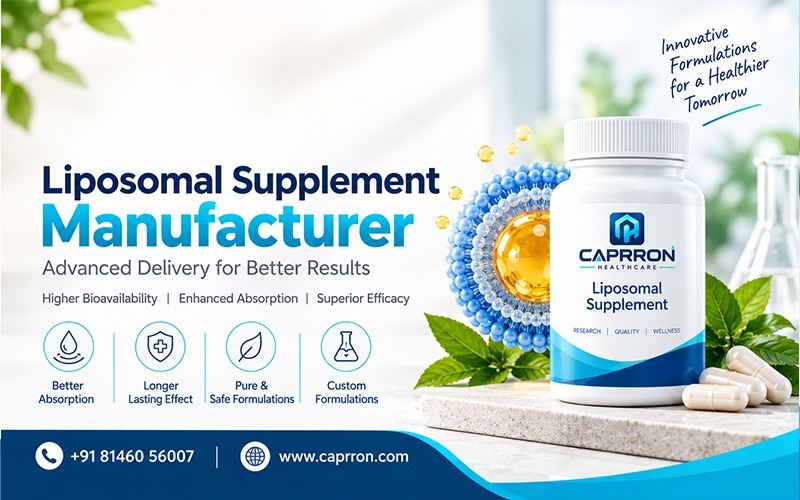
Liposomes are microscopic vesicles made primarily from phospholipids. These phospholipids contain a water-attracting head and fat-attracting tails. When arranged in an aqueous environment, they can form spherical structures with one or more lipid bilayers surrounding an internal compartment.
This structure allows liposomes to incorporate different types of ingredients, depending on their chemical properties. Water-soluble ingredients may be incorporated into the internal aqueous compartment, while certain fat-soluble ingredients can associate with the lipid bilayer.
Manufacturing these products requires more than simply mixing nutrients with oils. Formulation scientists must evaluate the interaction between the active ingredient and lipid system, the production process, particle characteristics, storage conditions, and the finished product’s stability.
A qualified manufacturer should be able to explain which parts of the process it can perform in-house and which may require external technical support.
How Does Liposomal Supplement Technology Work?
Liposomal technology uses phospholipid structures to encapsulate or associate with selected active ingredients.
The process generally involves preparing a lipid phase, combining suitable ingredients under controlled conditions, and applying an appropriate production method to form liposomal structures. Depending on the formulation, additional processing may be necessary to achieve the desired particle-size distribution and product characteristics.
The finished formulation must then be assessed to determine whether it meets established quality specifications.
1. Phospholipid Selection
Phospholipids are central to liposome formation. Their source, purity, composition, and compatibility with the active ingredient can affect the characteristics of the final formulation.
Manufacturers must evaluate the selected lipid materials for their suitability, quality, and intended application.
2. Active Ingredient Encapsulation
The active ingredient is incorporated into the formulation using a suitable preparation method. Encapsulation efficiency depends on several variables, including the ingredient’s solubility, lipid composition, processing conditions, and formulation design.
Not every ingredient can be incorporated efficiently into every liposomal system.
3. Particle Size and Uniformity
Particle size and size distribution can influence the physical properties, stability, and performance of a liposomal formulation. Depending on the product, manufacturers may use techniques such as dynamic light scattering to evaluate particle size and polydispersity.
The appropriate specifications depend on the formulation and its intended use.
4. Stability and Quality Evaluation
The finished product should be assessed for relevant quality characteristics, including ingredient content, physical stability, microbial quality, and packaging compatibility.
Where relevant, testing may also examine encapsulation efficiency, lipid oxidation, leakage of encapsulated ingredients, and changes in particle characteristics during storage.
These evaluations help establish whether the product continues to meet its specifications throughout its intended shelf life.
Benefits and Potential Applications of Liposomal Supplements
Liposomal technology offers formulation opportunities for supplement developers, but its advantages depend on the ingredient, formulation design, and supporting evidence.
Potential Formulation Advantages
- Ingredient encapsulation: Liposomes can accommodate selected water-soluble and fat-soluble ingredients.
- Protection of sensitive ingredients: An appropriate lipid system may help protect certain ingredients from environmental factors, although protection varies by formulation.
- Formulation flexibility: Liposomal systems can be developed for different nutrients and product concepts.
- Product differentiation: Liposomal delivery can help brands create specialized supplement ranges.
- Research opportunities: Liposomal formulations can be evaluated for their effects on ingredient stability, bioavailability, and delivery characteristics.
It is important to distinguish between a formulation’s technical potential and demonstrated benefits in people. Liposomal products do not automatically provide better absorption or superior health outcomes than conventional supplements. These claims require suitable evidence for the specific formulation and ingredient.
Common Areas of Liposomal Supplement Development
Depending on technical feasibility, regulatory requirements, and available evidence, liposomal technology may be explored for:
- Vitamin C formulations.
- Selected vitamin B formulations.
- Certain antioxidant ingredients.
- Glutathione formulations.
- Selected botanical or plant-derived compounds.
- Other nutrients for which a liposomal delivery approach is appropriate.
The suitability of each ingredient must be assessed individually. Some nutrients may be difficult to encapsulate efficiently or may require specialized processing and storage conditions.
Types of Liposomal Supplement Products
Businesses considering liposomal manufacturing should first determine the most appropriate product format. Different dosage forms create different requirements for processing, packaging, consumer use, and stability.
1. Liquid Liposomal Supplements
Liquid products can offer convenient administration and may be suitable for certain liposomal formulations. However, they require careful control of physical stability, microbial quality, flavour, and packaging.
Manufacturers should evaluate whether refrigeration, light protection, or other storage measures are needed.
2. Liposomal Powder Formulations
Powdered liposomal products may be developed using suitable drying or encapsulation technologies. These processes can affect the structure of the lipid system, so the product must be assessed after processing and, where applicable, after reconstitution.
Moisture control and packaging selection are especially important for powders.
3. Liposomal Capsules
Capsules may provide a convenient format for certain liposomal ingredients. Depending on the formulation, the contents may be liquid, powder, or another suitable preparation.
The manufacturer must establish compatibility between the formulation, capsule shell, and packaging system.
For related manufacturing information, businesses can visit Softgel Manufacturer India to learn about softgel manufacturing as a separate supplement format. Softgels and liposomal capsules are not interchangeable technologies.
4. Combination Nutraceutical Formulations
Some product concepts combine several nutrients or complementary ingredients. Such formulations require additional compatibility assessments because ingredients may interact with the lipids, affect stability, or change the final product’s physical characteristics.
A combination product should be developed around a clear formulation rationale rather than simply increasing the number of ingredients.
Liposomal Supplement Manufacturing Process: Step by Step
A structured manufacturing process supports consistency, traceability, and product quality. The exact process depends on the formulation and production equipment.
Step 1: Product Requirement Assessment
The process begins with a product brief covering the intended ingredients, dosage form, serving size, target market, packaging preference, and regulatory category.
The manufacturer should also discuss the proposed claims and any special storage or distribution requirements.
Step 2: Ingredient and Raw Material Selection
Suitable phospholipids, active ingredients, excipients, and other formulation materials are selected according to established specifications.
Supplier qualification, certificates of analysis, identity testing, and appropriate contaminant testing may form part of the material approval process.
Step 3: Formulation Development
The formulation is designed to achieve the desired ingredient concentration, physical characteristics, and stability profile.
Development work may involve evaluating lipid ratios, pH, processing conditions, ingredient compatibility, and other variables that influence the product.
Step 4: Liposome Preparation
An appropriate production technique is selected according to the formulation. Possible methods include thin-film hydration, ethanol injection, homogenisation, or other suitable processes.
Not every method is appropriate for every ingredient or commercial production scale.
Step 5: Particle Characterisation
Where relevant, the liposomal system is evaluated for particle size, size distribution, and other characteristics that support the product’s specifications.
Additional tests may be needed to assess encapsulation efficiency and distinguish liposomal material from unencapsulated ingredients.
Step 6: Filling and Packaging
The formulation is filled into suitable containers or dosage forms under appropriate controls. Packaging selection should consider oxygen exposure, light sensitivity, moisture, compatibility, and protection during transportation.
Step 7: Quality Control and Batch Release
Finished-product testing is performed according to approved specifications and the product’s regulatory classification.
The release process should include appropriate documentation, review of test results, and traceability of raw materials and production batches.
Step 8: Stability Assessment
Stability studies help determine whether the product maintains its specified quality under defined storage conditions.
The results support shelf-life decisions and storage instructions. Shelf life should not be assigned solely on the basis of ingredient supplier information or initial testing.
Quality Standards to Evaluate in Liposomal Supplement Manufacturing
Quality is especially important in liposomal formulations because the product’s characteristics may change during production and storage.
Before selecting a manufacturing partner, businesses should ask how the company establishes, monitors, and documents product quality.
Raw Material Quality
Raw materials should meet appropriate specifications. Relevant checks may include identity, purity, potency, microbial limits, and contaminants such as heavy metals, where applicable.
Phospholipid quality is particularly important because variations in composition or oxidation can influence the finished formulation.
Manufacturing Controls
Manufacturing procedures should define the required processing conditions, equipment controls, cleaning practices, and documentation.
Where applicable, businesses should verify that the manufacturing facility operates under the relevant GMP requirements for the product category.
Finished Product Testing
Testing requirements vary by product, but may include:
- Active ingredient identity and content.
- Microbial limits and other microbiological tests, where applicable.
- Particle size and size distribution, when relevant.
- Encapsulation efficiency, where claimed or required.
- Physical appearance and homogeneity.
- pH and viscosity for applicable liquid products.
- Lipid oxidation or degradation indicators, where relevant.
- Packaging compatibility and stability.
Not every test applies to every product. A scientifically justified specification should reflect the formulation and intended use.
Documentation and Traceability
A reliable quality system should support batch records, raw material traceability, deviation management, approved specifications, and documented release decisions.
Businesses should request relevant quality documentation and verify claims about certifications or manufacturing capabilities rather than relying on general marketing statements.
How to Choose the Right Liposomal Supplement Manufacturer in India
Selecting a manufacturing partner is a significant decision for a nutraceutical business. A manufacturer that produces conventional tablets or capsules may not necessarily have the specialised capabilities needed for liposomal formulations.
Consider the following factors before proceeding.
1. Liposomal Formulation Expertise
Ask whether the manufacturer has actual experience developing or producing liposomal products. Request information about its formulation capabilities, relevant equipment, and previous work that it is authorised to disclose.
Experience with conventional supplements alone does not establish liposomal manufacturing expertise.
2. Research and Development Support
Formulation development may require multiple trials to achieve the required ingredient loading, particle characteristics, and stability.
Discuss the availability of technical personnel, development timelines, testing resources, and the process for approving a final formula.
3. Quality Assurance Systems
Review the facility’s applicable quality certifications, GMP status, testing arrangements, and documentation practices.
Confirm that the quality systems are appropriate for the specific product and target market.
4. Production Capacity and Scalability
A formulation that works in a small development batch may behave differently at commercial scale. Ask how the manufacturer evaluates scale-up, process consistency, and batch-to-batch variation.
Production capacity should match both the initial order and realistic future demand.
5. Packaging and Storage Support
Packaging should protect the formulation under its intended storage and distribution conditions. Discuss container selection, closure systems, light protection, oxygen exposure, and any temperature-control requirements.
6. Regulatory and Labelling Support
The manufacturer should clarify which regulatory responsibilities it can support and which remain with the brand owner.
Product classification, permitted ingredients, claims, labelling, and manufacturing permissions must be checked for the target market.
7. Commercial Terms and Minimum Order Quantities
Before placing an order, review the minimum batch size, development charges, testing costs, packaging expenses, payment terms, lead times, and arrangements for rejected or nonconforming batches.
A transparent quotation makes it easier to compare manufacturers on total project cost rather than unit price alone.
Liposomal Supplement Third-Party Manufacturing for Supplement Brands
Third-party manufacturing can allow a business to work with an external manufacturer instead of establishing its own production facility. This model may be useful for brands that want to focus on marketing, distribution, product positioning, and customer relationships.
However, outsourcing production does not remove the need for proper supplier qualification and product oversight.
A typical third-party manufacturing project may involve:
- Defining the product concept and target customer.
- Confirming the ingredient list and intended dosage form.
- Assessing whether the manufacturer can produce the required liposomal system.
- Agreeing on product specifications and quality testing.
- Finalising packaging, branding, and label requirements.
- Reviewing commercial terms and the production schedule.
- Approving samples and documentation before commercial manufacture.
- Monitoring product quality and addressing any issues after launch.
Businesses looking for broader manufacturing arrangements can review Caprron’s Nutraceutical Third Party Manufacturer page.
For brands that require a more customised arrangement, the Nutraceutical Contract Manufacturing page provides additional information about the contract manufacturing model.
Before signing an agreement, clearly establish ownership of the formulation, confidentiality requirements, product specifications, responsibilities for regulatory compliance, and procedures for handling quality complaints.
Private Label Liposomal Supplements: Building Your Own Brand
Private-label manufacturing allows businesses to market products under their own brand using an agreed manufacturing arrangement. It can be useful for entrepreneurs, supplement distributors, wellness businesses, and established brands expanding their product portfolios.
A liposomal supplement private-label project typically requires decisions about the product’s intended audience, ingredient composition, serving size, packaging, label design, and market positioning.
Important Steps for Private Label Development
- Choose a suitable product concept: Identify the nutritional need and target customer without making unsupported health claims.
- Confirm formulation feasibility: Check whether the proposed ingredients can be incorporated into a suitable liposomal system.
- Define quality specifications: Establish measurable requirements for ingredient content, stability, and other relevant characteristics.
- Select packaging: Choose packaging that supports the formulation’s storage and handling requirements.
- Review the label: Confirm that the ingredients, serving instructions, warnings, claims, and mandatory declarations meet applicable regulations.
- Plan distribution: Consider shelf life, storage conditions, shipping, and inventory management before launching.
Businesses can explore Private Label Nutraceutical Manufacturer for information about private-label nutraceutical manufacturing.
Regulatory Considerations for Liposomal Supplements in India
Regulatory compliance should be considered during product development rather than after manufacturing is complete.
In India, the regulatory pathway depends on the product’s classification, composition, intended use, and claims. Many health supplements and nutraceuticals fall under the Food Safety and Standards Authority of India (FSSAI) framework, while other products may be subject to different requirements.
Businesses should verify the applicable category and current regulations before finalising the formulation.
Important considerations include:
- Permitted ingredients and applicable ingredient limits.
- Relevant manufacturing and business licences.
- Product composition and quality requirements.
- Labelling and mandatory declarations.
- Serving instructions, warnings, and allergen information where applicable.
- Advertising and health-claim restrictions.
- Import, export, and destination-market requirements.
- Documentation supporting product quality and stated claims.
The official Food Safety and Standards Authority of India website is a useful starting point for checking food safety and nutraceutical regulations in India.
A manufacturer may provide technical documentation or regulatory assistance, but the brand owner should confirm who is responsible for each compliance obligation.
Challenges in Liposomal Supplement Manufacturing
Liposomal products can present technical challenges that need to be addressed during development.
Formulation Stability
Lipid structures may change during storage, and some lipid materials are susceptible to oxidation. Ingredient interactions, temperature, pH, and exposure to light or oxygen can affect product quality.
Appropriate formulation design, packaging, and stability testing are therefore essential.
Encapsulation Efficiency
Some ingredients may be difficult to incorporate into liposomes at commercially useful concentrations. The formulation team must assess how much of the active ingredient is encapsulated and how much remains outside the liposomal structures.
The method used to measure encapsulation efficiency should be suitable and validated for the formulation.
Manufacturing Scale-Up
Increasing batch size can change mixing, temperature distribution, processing time, and other variables. Scale-up studies help establish process parameters that produce consistent results.
Cost Management
Specialised raw materials, development work, analytical testing, and protective packaging can increase production costs. A cost-effective product should balance commercial requirements with the need for reliable quality.
Evidence for Product Claims
Brands should avoid assuming that a product is superior simply because it uses liposomal technology. Claims about enhanced absorption, improved bioavailability, or specific health outcomes should be supported by relevant evidence and comply with applicable regulations.
Liposomal Supplements Compared With Conventional Supplements
Liposomal and conventional supplements differ mainly in their formulation approach.
| Feature |
Liposomal supplements |
Conventional supplements |
| Delivery approach |
Uses phospholipid vesicles to encapsulate or associate with selected ingredients |
Uses standard dosage forms or delivery systems |
| Formulation complexity |
Often requires additional lipid-system development and characterisation |
Depends on the dosage form and ingredients |
| Quality assessment |
May require particle and encapsulation testing in addition to standard tests |
Requires tests appropriate to the formulation |
| Packaging needs |
Depends on lipid stability and product characteristics |
Depends on ingredient and dosage-form stability |
| Cost considerations |
May involve specialised processing and testing costs |
Varies with ingredients and manufacturing requirements |
| Performance evidence |
Must be evaluated for the specific formulation |
Must also be evaluated for the specific formulation |
Neither approach is automatically better for every ingredient. Product selection should be based on scientific evidence, formulation suitability, quality, cost, and the intended use.
Related Nutraceutical Manufacturing Opportunities
Businesses developing a liposomal supplement range may also consider other nutraceutical formats, depending on their customers’ needs and the technical feasibility of each product.
These formats have different technical and regulatory requirements. A business should select a dosage form based on the product’s intended use, formulation feasibility, consumer preferences, and applicable regulations.
Important Questions to Ask a Liposomal Supplement Manufacturer
Before choosing a manufacturing partner, request clear answers to the following questions:
- Does the company currently manufacture liposomal supplements, or does it only offer conventional nutraceutical products?
- Which liposomal preparation methods and analytical techniques are available?
- Can the manufacturer demonstrate suitable experience with the proposed active ingredient?
- What specifications are used for particle size, encapsulation efficiency, and ingredient content?
- How is lipid oxidation and physical stability monitored?
- What stability data are available to support the proposed shelf life?
- Which quality certifications and manufacturing licences apply to the facility and product?
- Are testing activities performed in-house or through qualified external laboratories?
- What are the minimum order quantity, development cost, and expected lead time?
- Who is responsible for formulation ownership, labelling, regulatory documentation, and post-market quality issues?
The answers can help distinguish a manufacturer with relevant liposomal expertise from a company that offers only general nutraceutical manufacturing.
Conclusion: Selecting a Liposomal Supplement Manufacturer in India
Choosing the right Liposomal Supplement Manufacturer requires careful consideration of formulation expertise, manufacturing capabilities, ingredient quality, analytical testing, regulatory compliance, packaging, and commercial terms. Liposomal technology can offer useful formulation opportunities for selected nutrients, but its effectiveness and stability depend on the specific product and the evidence supporting its performance.
For nutraceutical brands, the best approach is to define clear product requirements, evaluate potential manufacturers against documented capabilities, and confirm the quality and regulatory requirements before commercial production begins.
Caprron Healthcare offers a range of pharmaceutical and nutraceutical manufacturing services that businesses can explore when planning a supplement portfolio. Companies interested in liposomal products should directly confirm the availability of specialised liposomal formulation and production services, along with the required testing and documentation.
A well-planned manufacturing partnership can help businesses develop a product that meets defined quality standards, fits their commercial objectives, and complies with the requirements of the intended market.
Frequently Asked Questions About Liposomal Supplement Manufacturers
1. What is a liposomal supplement manufacturer?
A liposomal supplement manufacturer develops or produces nutritional supplements that use phospholipid vesicles to encapsulate or associate with selected active ingredients. Its responsibilities may include formulation development, production, testing, filling, packaging, and quality documentation, depending on the services offered.
2. What are liposomal supplements used for?
Liposomal supplements are developed for selected nutrients, vitamins, antioxidants, and other nutritional ingredients. The suitability of liposomal delivery depends on the ingredient, formulation, intended use, and available scientific evidence.
3. Are liposomal supplements better than conventional supplements?
Not necessarily. Some liposomal formulations may influence the stability or bioavailability of particular ingredients, but the results vary. Claims of improved absorption or health benefits should be supported by evidence for the specific formulation.
4. Which ingredients can be used in liposomal supplements?
Potential ingredients include vitamin C, selected B vitamins, glutathione, certain antioxidants, and other compatible nutrients. Each ingredient requires a feasibility assessment to determine its encapsulation characteristics, stability, and suitability for the intended product.
5. How do I choose a liposomal supplement manufacturer in India?
Evaluate the manufacturer’s liposomal experience, formulation development capabilities, quality systems, testing methods, production capacity, regulatory knowledge, packaging options, and commercial terms. Ask for evidence of relevant capabilities before committing to a project.
6. Can I launch my own liposomal supplement brand?
Yes, a business may be able to develop a branded liposomal supplement through a suitable contract or private-label manufacturing arrangement. The proposed formulation, manufacturing capability, product classification, labelling, and required licences must be confirmed first.
7. What quality tests are important for liposomal supplements?
Depending on the formulation, tests may include active ingredient content, particle size, size distribution, encapsulation efficiency, microbial quality, physical stability, lipid oxidation, and packaging compatibility. The final testing plan should be based on a scientifically justified product specification.
8. What affects the shelf life of a liposomal supplement?
Shelf life can be affected by lipid composition, active ingredients, temperature, light, oxygen, moisture, pH, packaging, and manufacturing conditions. Stability studies under appropriate conditions are needed to support the proposed expiry date.
9. Are liposomal supplements regulated in India?
The applicable requirements depend on product classification, ingredients, intended use, and claims. Products classified as health supplements or nutraceuticals may fall under the FSSAI framework, but businesses should verify the current rules and applicable category before launching.
10. What is the difference between liposomal capsules and softgels?
Liposomal describes a delivery technology involving phospholipid structures. A capsule or softgel describes a dosage form. A liposomal ingredient may be incorporated into a suitable dosage form if the formulation and manufacturing process support it, but not every capsule or softgel is liposomal.
11. Can liposomal supplements be manufactured as powders?
Yes, certain liposomal formulations can be converted into powders using suitable technologies. The process must be evaluated carefully because drying and reconstitution can affect liposome structure, particle size, and stability.
12. What should I confirm before placing a manufacturing order?
Confirm the final formula, ingredient specifications, quality tests, packaging, shelf-life evidence, regulatory responsibilities, minimum order quantity, pricing, delivery schedule, and ownership of the formulation. Ensure that the manufacturer can support the specific liposomal technology required.
13. Does Caprron Healthcare manufacture liposomal supplements?
Caprron Healthcare offers pharmaceutical and nutraceutical manufacturing services. Businesses should contact the company directly to confirm whether its current capabilities include the required liposomal formulation, production technology, dosage form, and specialised quality testing.
14. Why is stability testing important for liposomal supplements?
Stability testing helps establish whether the formulation maintains its required quality throughout storage. It can identify changes in ingredient content, particle characteristics, lipid integrity, appearance, and microbiological quality, where applicable.
15. Is liposomal technology suitable for every nutraceutical ingredient?
No. Suitability depends on the ingredient’s chemical properties, compatibility with the lipid system, desired concentration, manufacturing process, stability, and supporting evidence. A formulation feasibility assessment should be completed before commercial production.